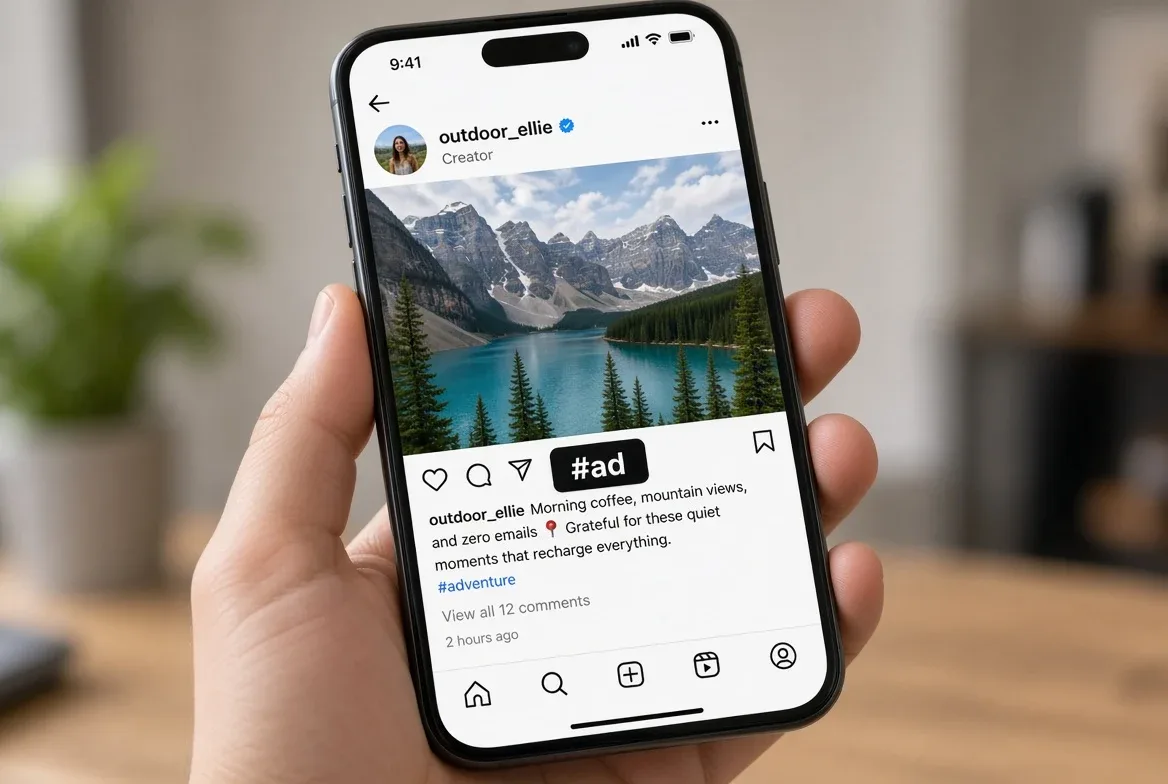
The Federal Trade Commission requires creators to disclose any 'material connection' to a brand -- payment, free or discounted products, or a personal or employment tie -- clearly and inside the endorsement itself, not in a bio or behind a 'more' button. The rule applies even when a brand never asked for the mention.
What counts as a material connection under FTC rules?
A material connection is any financial, employment, personal, or family relationship with a brand that could affect how a reasonable follower reads an endorsement. Free or discounted products count, even a single item. The FTC's disclosure guidance states plainly that a creator should disclose 'if you got anything of value to mention a product,' regardless of who initiated the mention.
The connection does not need to be a cash payment. It can be a loaned product, a trip, event tickets, an equity stake, or a family tie to a brand's founder. The FTC's guidance for influencers notes that tags, likes, and pins can themselves function as endorsements requiring disclosure when they promote a brand in exchange for something of value. U.S. disclosure law applies whenever a post reasonably reaches U.S. consumers, regardless of where the creator is based. No disclosure is required only when there is genuinely no brand relationship behind the mention -- an unpaid, unprompted recommendation of a product the creator bought independently.
Where does the disclosure have to appear?
The disclosure has to sit with the endorsement itself, not in a profile bio, at the bottom of a caption, or behind a 'see more' link. On Instagram it needs to appear in the first two or three lines; on YouTube, near the start of a video, since many viewers skip the description entirely.
Video and livestream endorsements need audible or on-screen disclosure inside the clip, since a viewer can join a stream mid-broadcast or scroll past a caption without reading it. Photo-based posts on Instagram or Snapchat should have the disclosure superimposed on the image itself, on screen long enough to be read. A one-word hashtag like #sp, #spon, or #collab does not meet the bar, according to the FTC's guidance, because it does not clearly say the post is paid or sponsored. Neither does a disclosure buried only in a pinned comment or a separate story slide a viewer might skip past.
What language actually satisfies the FTC?
Plain, unambiguous wording works: 'ad,' 'sponsored,' 'paid partnership,' or a full sentence such as 'Brand paid me to try this.' Hashtags like #ad are acceptable when placed prominently, ideally at the start of a caption rather than buried at the end among unrelated tags.
The FTC's own examples include lines like 'Thanks to Acme brand for the free product' paired with '#AcmePartner #ad,' and platform-native labels such as a paid-partnership tag. What the agency rejects is vagueness: a standalone 'thanks,' an abbreviation like 'sp,' or a disclosure phrased so casually that a follower could read the post as a spontaneous, unpaid opinion. The guidance is consistent across formats -- the test is whether an ordinary reader, glancing quickly, would understand the post is an ad.
| Format | Where the disclosure belongs | What does not satisfy it |
|---|---|---|
| Instagram feed post | First two to three lines of the caption, or superimposed on the image | Bio-only mention; disclosure after 'more' |
| YouTube video | Spoken or on-screen near the start of the video | Description-only disclosure |
| Instagram or Snapchat Stories | Superimposed text, visible long enough to read | Small text easy to miss in seconds |
| Livestream | Repeated periodically through the broadcast | A single disclosure only at the start |
| X or Facebook post | Beginning of the post text | Disclosure placed at the very end |
The logic behind the table is consistent across every row: a disclosure only works if a follower encounters it in the same moment and the same format as the endorsement itself. A viewer scrolling a feed at speed, watching a video on mute, or catching thirty seconds of a livestream should not have to hunt for the fact that a post is paid. Placement is treated as part of the disclosure, not a formality layered on top of it.
What else do the Endorsement Guides restrict, beyond disclosure?
Disclosure is not the only line the guides draw. A creator cannot endorse a product they have not actually tried, cannot make a health or scientific claim that would require clinical proof to back up, and cannot praise a product publicly while privately disliking it just because a brand paid for the post. The FTC's guidance treats these as extensions of the same principle: an endorsement has to reflect the endorser's honest, current opinion, not a script written to sound like one.
That matters for how sponsored content gets produced day to day. A creator who is handed brand talking points can still use them, but the underlying opinion in the post has to be their own, and any claim that goes beyond ordinary experience -- a supplement's health effect, a skincare product's clinical result -- needs the same substantiation an advertiser itself would need before running the claim.
Who is actually responsible for compliance -- the creator or the brand?
Both are, under FTC guidance, but the agency is explicit that creators cannot outsource the obligation to the brand paying them. Its influencer guidance states directly that it is the creator's own responsibility to be familiar with the Endorsement Guides and to comply with laws against deceptive advertising, not only the marketer's job to instruct them correctly.
Skipping disclosure exposes both sides to enforcement under laws against deceptive advertising. The FTC can pursue formal orders, and violating an existing order can carry civil penalties. In practice, publicized enforcement has more often targeted brands and marketing agencies running large, coordinated campaigns than individual creators acting alone, but the underlying disclosure rule applies to anyone posting an endorsement, regardless of follower count. A small account with a genuine brand relationship is bound by the same standard as a creator with millions of followers -- the guides do not set a subscriber or follower threshold below which disclosure becomes optional.
For a related fame perspective, read What creators actually have to disclose in a paid partnership.
For more context, read What a brand deal actually pays, and how the rate is set.