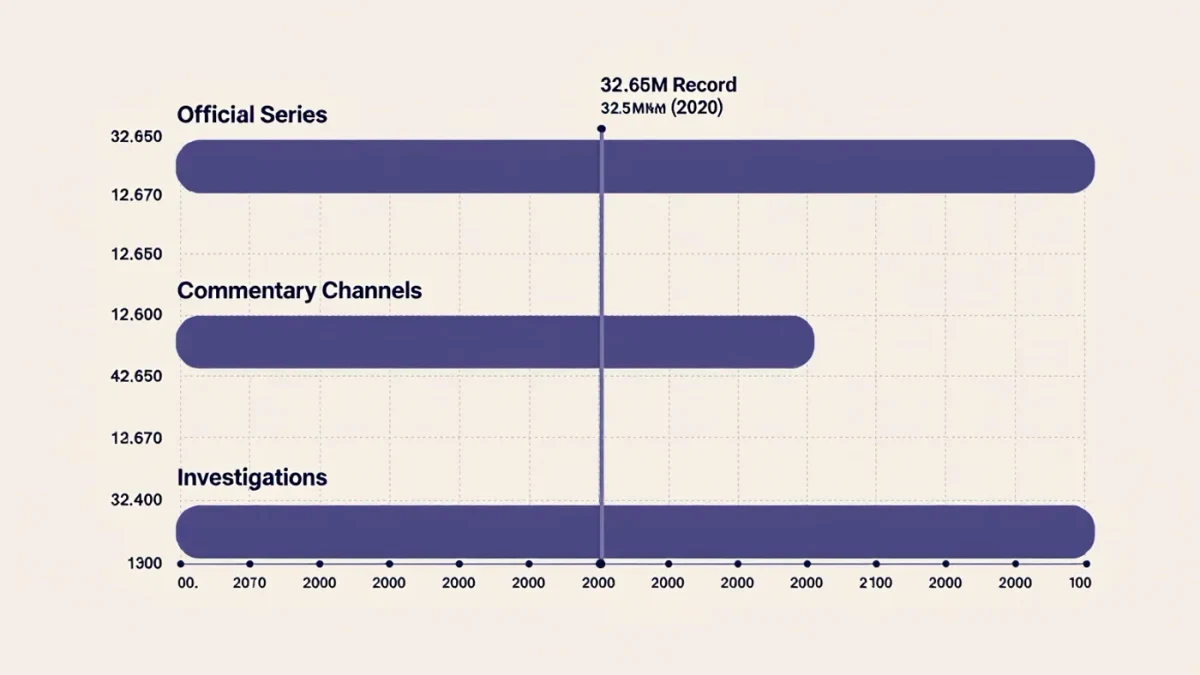
YouTube celebrity documentaries come in three tiers: official docuseries released with the star's participation, independent commentary channels covering stars without consent, and investigative series built on public records. The format draws nine-figure view counts at the top end, and it operates with fewer editorial rules than broadcast television, which shapes both its reach and its risks.
What are the main formats?
Three formats dominate. Official docuseries are produced with the star and released on their channel or a platform brand; commentary channels narrate career arcs and controversies using clips under fair-use claims; investigative channels build original reporting into multi-part series. Each tier has different access, different economics and different obligations to accuracy.
Official productions set the format's ceiling. Justin Bieber: Seasons, released through YouTube Originals in January 2020, documented the making of an album and the star's return to touring, while Demi Lovato: Dancing with the Devil followed in March 2021, covering the aftermath of a 2018 medical emergency with the artist's direct participation. Both were event releases with trailers, episode schedules and press coverage, not casual uploads.
| Tier | How it is made | Subject participation | Typical revenue |
|---|---|---|---|
| Official docuseries | Produced with the star and label | Full, with approval | Platform or label financing |
| Commentary channels | Narration over compiled clips | None | Advertising on long videos |
| Investigative series | Original research and interviews | Usually refused | Ads, sponsors, memberships |
The independent tier is larger and less formal. It ranges from nightly drama roundup channels to researched video essays, and it treats celebrity careers as ongoing subject matter the way sports channels treat teams. The scale is a product of the platform's economics: a video about a famous person is searchable forever, so it earns for years.
Why do stars greenlight official documentaries?
Control and timing. An official docuseries lets a star narrate a comeback, address a difficult period on their own terms, and attach the story to a release cycle, while retaining approval over footage. Labels and studios co-finance because the format reliably converts attention into first-week consumption.
Bieber's series ran alongside the February 2020 release of his album Changes, and Lovato's series shared its name with an album released weeks later. The documentary is the announcement: it frames the narrative a rollout needs, from comeback to candor, and it lives permanently on the channel as a press kit that plays itself.
The financing shifted after the platform retreated. YouTube wound down its Originals slate by 2023, and official documentaries migrated to artists' own channels and label channels, where they now premiere alongside tours and album cycles. The star's team keeps the advertising revenue and the audience data, which makes the format cheaper than a network special and easier to schedule around a campaign.
How do independent channels cover stars?
Through compilation, narration and clip-driven storytelling, usually without the subject's participation. Commentary channels assemble publicly available footage into career retrospectives and controversy explainers, narrating over clips they argue are fair use. The subject has no approval rights and typically learns of the video when it trends.
The best documented example is D'Angelo Wallace's 2020 multi-part series on Shane Dawson, which drew millions of views and coincided with broad commercial fallout for its subject, including YouTube suspending monetization on several of his channels that July. The series showed that an independent narrator with a research process could affect a star's business relationships faster than any magazine profile.
Investigative channels work differently. Coffeezilla's multi-part investigations into crypto collapses, including the FTX exchange, rely on original interviews and public records rather than rumor, and they routinely draw millions of views per installment. Fredrik Knudsen's Down the Rabbit Hole series applies a slower archival method to internet figures. Both borrow from journalism while operating outside its institutions.
What the tiers share is dependency on platform clips. Commentary channels assert fair use over footage they did not shoot, a position that holds until a rights holder objects, and drama-oriented accounts that repeat unverified claims face takedowns and audience criticism when the claims fail. The result is a format that moves fast and corrects slowly.
What ethics rules apply?
Fewer than broadcast, and mostly self-imposed. YouTube's policies cover monetization, harassment and reused content rather than journalistic standards, so accuracy norms on documentary channels are enforced by reputation, audience pushback and defamation law rather than an editorial layer. Right of reply is rare in practice.
YouTube's 2019 creator responsibility policy established that conduct off the platform can limit monetization on it, and the company has applied monetization suspensions in documented celebrity controversies. That is a business consequence, not an editorial judgment, and it does not require any claim in the underlying videos to be true.
Monetization shapes the format as much as policy does. Videos longer than eight minutes carry mid-roll advertising, which rewards stretched runtimes, and thumbnails compete for clicks, which rewards conflict. Viewers comparing a creator documentary with a broadcast one should assume different pressures, not just different production values.
Subjects rarely get a preview. Retractions and corrections happen at the creator's discretion, and disputes over false claims have played out publicly, but there is no standards desk to appeal to. The practical check is reputational: channels that spend accuracy once tend to lose the credibility that funds the next series.
How big are the audiences?
Large enough to anchor the format. The premiere of Justin Bieber's Seasons drew 32.65 million views in its first week in 2020, a YouTube Originals debut record, and successful independent takedowns and investigations routinely clear several million views per installment. The scale is what pulled labels and studios in.
| Series | Tier | Year | Documented result |
|---|---|---|---|
| Justin Bieber: Seasons | Official | 2020 | 32.65 million first-week views, platform debut record |
| Demi Lovato: Dancing with the Devil | Official | 2021 | Artist-led participation, album-timed release |
| Wallace series on Shane Dawson | Commentary | 2020 | Millions of views across installments |
| Coffeezilla crypto investigations | Investigative | 2022-2024 | Millions of views per installment |
For managers, the takeaway is that the format is now standard inventory. A docuseries on the artist's channel is budgeted into album campaigns the way music videos are, and independent coverage is treated as an environmental condition to be monitored rather than a request to be approved.
What should viewers weigh?
Who paid for the video and what it needs from you. Official docs are marketing assets with consent but also narrative control; independent docs trade access for independence and monetize attention. In both tiers, runtime and thumbnail incentives reward drama over proportion.
The checklist is short. Check whether the subject participated, who funds the channel, and whether the video cites dated, checkable sources. Treat runtime with suspicion: a story that needs two hours usually has thirty minutes of argument and ninety of repetition. Thumbnail conflict, likewise, is a marketing decision made before a single claim is written.
The format looks stable as of 2025. Official docs have become routine parts of release campaigns, commentary channels have professionalized into small studios, and investigations have shown they can move real-world outcomes. The audience decides each tier's credibility video by video, which is the format's premise and its weakness at once.