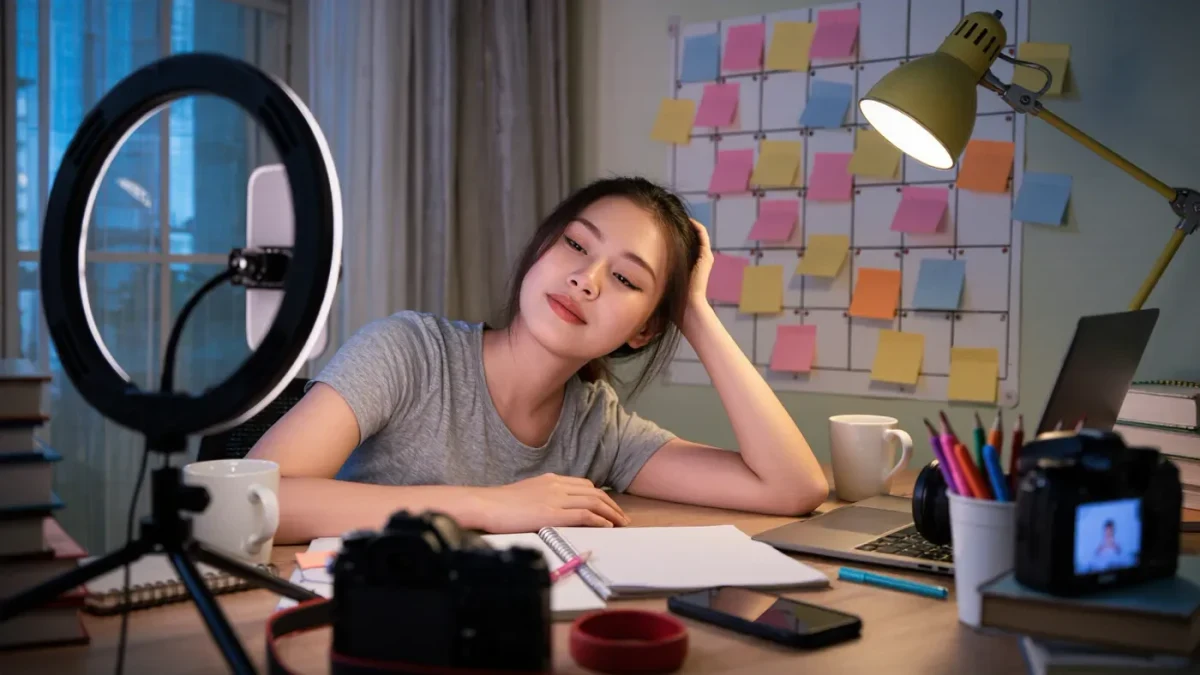
Creator burnout is the exhaustion of a job with no finish line: platforms reward consistent, recent posting, so rest days feel like professional risk. The pressure is structural — algorithms surface active accounts, audiences expect rhythm, and income often tracks output volume. Creators who have spoken on record describe the same mechanism: the schedule itself is what wears them down.
Why does a posting schedule cause burnout?
Three forces compound. First, recency-based distribution: platforms favor accounts that post frequently and recently, which converts rest days into distribution risk. Second, audience conditioning: once a creator establishes a rhythm, the audience expects it, and gaps draw questions before they draw relief. Third, income coupling: for creators whose revenue depends on views, cutting output cuts pay immediately, making the workload non-negotiable in the creator's mind.
The result is a job with none of the usual boundaries. There is no weekend, no season, no colleagues absorbing slack. Sports and wellness personalities including Simone Biles and Naomi Osaka brought athlete-burnout language into mainstream visibility in 2021 by withdrawing from competition to protect mental health — the same template high-output creators later cited when pausing their own channels.
Who has spoken about it on record?
The pattern of public pauses is well documented across creator generations. In 2019, Lilly Singh announced she would stop weekly uploads after years of a grueling schedule, citing the need to sleep and recover. Markiplier has discussed the unsustainable pressure of daily uploads and guilt over taking breaks. Dozens of mid-size creators describe the same arithmetic at smaller scale in interviews and industry surveys: infinite demand, finite person.
The recurring detail in these accounts is invisibility of the labor. Audiences see minutes of output and infer ease. The production chain — ideation, scripting, filming, editing, publishing, community management — runs continuously behind it, and on solo operations it all runs through one nervous system.
Which formats are most exposed?
Burnout risk is not evenly distributed across formats. Daily vlogging sits at the extreme end, because the content is the creator's life and the camera never leaves it — several of the most-cited burnout stories in YouTube history come from daily vlog channels that ended abruptly. Daily short-form is close behind: production per clip is small, but the tempo allows no recovery and the algorithm punishes pauses fastest.
Weekly long-form, podcasting and newsletters sit at the calmer end of the spectrum, with batch-friendly production and audiences conditioned to slower rhythm. The pattern to notice is recovery time built into the format. A creator choosing between formats is also choosing a rest schedule, whether they intend to or not.
What does burnout look like in practice?
Creator burnout presents in recognizable stages. Early signs resemble ordinary fatigue with a guilt component: relief when a video underperforms because at least the pressure lifts. Middle stages include cynicism toward the audience, sleep disruption around publishing windows, and creative paralysis — the ability to produce technically intact content that feels hollow. Late stages are walking away entirely, sometimes with abrupt channel abandonment that burns community trust.
Two structural aggravants make creator burnout distinctive. Parasocial demand means the audience relates to the person, not the product, so scaling output means scaling self-disclosure — a resource with hard limits. And algorithmic volatility means effort and reward decouple unpredictably, which is precisely the condition organizational psychology associates with the fastest exhaustion.
How do sustainable creators change the schedule?
The creators who last tend to restructure deliberately rather than push through. Common interventions:
- Reduce frequency to a sustainable fixed cadence — often from daily to two or three posts weekly — and announce it, so the audience recalibrates expectations.
- Batch production into concentrated shooting and editing blocks, creating genuine off-days between cycles.
- Build a buffer of finished content — ideally four to eight weeks — so illness or travel does not break the schedule.
- Diversify revenue away from pure view volume, so rest no longer means immediate income loss.
- Delegate editing and community management as soon as margins allow.
Each intervention attacks a specific pressure: cadence changes audience conditioning, buffers absorb shocks, revenue diversification breaks the income-output link, and delegation returns hours to the person.
What do platforms and industry data say?
Industry surveys have repeatedly quantified the problem. Creator-economy reports through 2024 and 2025 — including annual state-of-the-industry studies — have found that a majority of full-time creators report some level of burnout, with heavier publishing cadences correlating with worse scores. Platform responses have been partial: YouTube added holiday and sleep-schedule tools for uploads and has experimented with toning down public dislike metrics partly to reduce creator stress; none of these change the underlying incentive to publish.
The honest read is that the pressure is a business-model property. As long as distribution rewards recency, the schedule pressure will exist; the variable a creator controls is the structure around it.
What should a recovery plan include?
Creators who return from burnout successfully tend to treat recovery as an operational project rather than a vacation. The working template has four parts: a hard pause long enough to restore sleep — commonly four to eight weeks; an audit of which content actually drives revenue versus which merely feeds the calendar; a redesigned cadence set by production capacity, not by what competitors post; and a written definition of enough — a monthly output and income target that, once met, licenses stopping.
The last item matters most. Burnout thrives on undefined success, where no month is ever sufficient. A number on paper converts the job back into something with edges, which is what every sustainable creative career has eventually had to invent for itself.
When should a creator take a break?
The consistent advice from creators who have publicly recovered: take the break before the forced one. Practical triggers include dreading the work for consecutive weeks, sleep disruption tied to publishing, or content quality slipping in ways the audience notices. A planned pause — announced in advance, with a return date — protects both the person and the audience relationship far better than abrupt disappearance.
Audience data generally supports the fear being overestimated: channels that pause for weeks typically recover reach within a few posts after resuming, and the strongest correlation with long-term channel health is years-sustained output, not any single month's volume. The schedule is a means; the career is the asset.