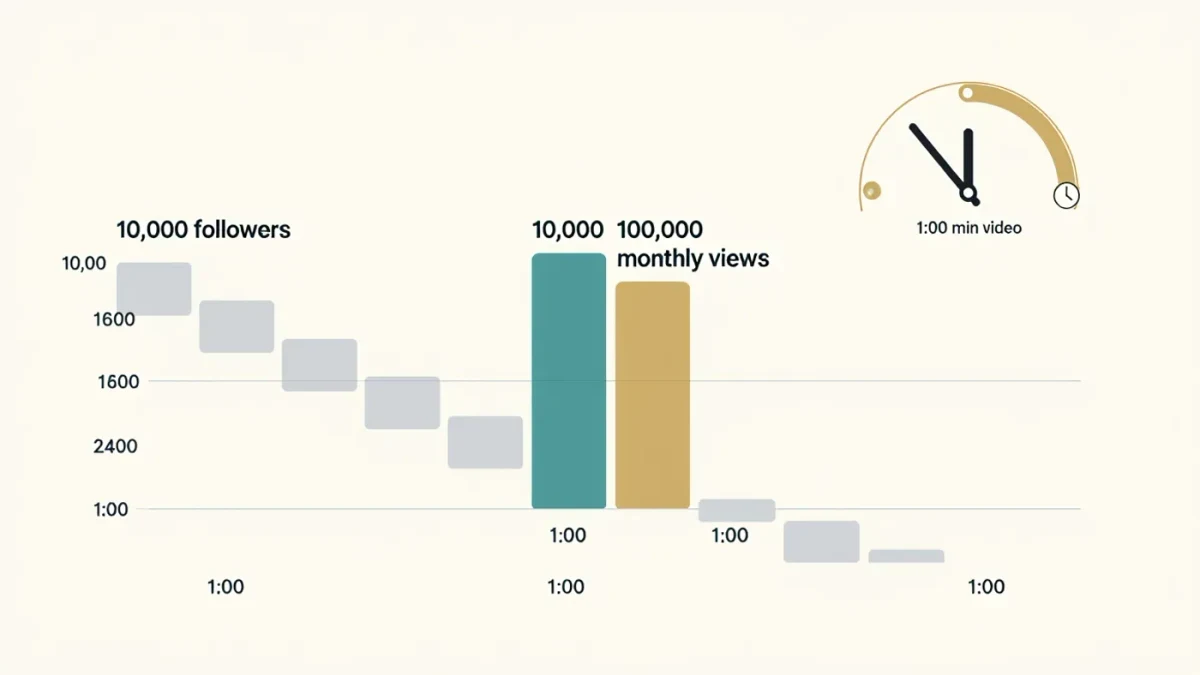
TikTok's Creator Rewards Program pays eligible creators for original videos longer than one minute, with eligibility set at 10,000 followers and 100,000 video views in the previous 30 days. The program replaced the older Creator Fund in most markets in 2023, and all payout figures creators cite are self-reported, since TikTok does not publish per-view rates.
Who qualifies for Creator Rewards?
There are four standing conditions, listed in TikTok's own program documentation as of 2025. A creator must be at least 18 years old, based in a country where the program operates, have at least 10,000 followers, and have collected at least 100,000 video views across their account in the last 30 days. The account also has to be in good standing, with no repeated Community Guidelines violations.
The follower and view numbers are minimums, not guarantees of income. Meeting them simply unlocks the ability to apply; each video is then evaluated on its own performance once the creator switches monetization on for it. TikTok describes the requirements as version-dated and subject to change, and the company has adjusted program mechanics more than once since 2020, which is worth remembering when comparing rates across years.
Why does video length matter?
Only videos longer than one minute are eligible for rewards, a deliberate change from the Creator Fund, which paid on short clips and became famous for pennies-per-thousand-views payouts. TikTok has said publicly that longer videos reward watch time and give creators more room for sponsor-friendly storytelling. The one-minute floor is strict: a 59-second video earns nothing from the program regardless of how it performs.
The requirement reshaped creator behavior on the platform. Vlog-style formats, mini-documentaries and multi-part storytime series became more common after 2023 partly because they fit the rewards window. Creators who built audiences on sub-minute comedy clips often reported choosing between their proven format and the monetizable one, a tension widely discussed in self-reported earnings posts throughout 2024 and 2025.
How are payouts calculated?
TikTok does not publish a fixed per-view rate. In its program materials, the company says rewards are based on qualified views, adjusted for factors including watch time completion, engagement, authenticity of the audience and whether the video is original. In practice, creators report effective earnings anywhere from a few cents to roughly a dollar per 1,000 qualified views, with high-completion long videos at the top of that range. Those figures are self-reported and unaudited.
Qualified views have their own definition: TikTok counts views from real, engaged users, filtered through its fraud systems, and excludes certain replays and traffic it classifies as low quality. Videos also must be watched past a minimum duration to count toward rewards eligibility, which is another reason average payout per view varies so much between creators with identical follower counts.
What counts as original content?
The originality condition is the program's most enforced rule. Videos must be created and posted by the account owner, and TikTok excludes content it identifies as reposted, stitched together from other creators' work, or built predominantly on unlicensed third-party material. Watermarked videos republished from other platforms are explicitly disqualified, a rule that dates from the program's earliest version and remained in place as of 2025.
Enforcement is automated, and creators periodically report videos rejected for originality despite being their own work. Appeals exist inside the app, but there is no external audit process, which is one of the program's recurring criticisms. Unlike YouTube's published 55/45 split, TikTok's reward formula is a black box, so creators can compare payout screenshots but cannot verify why two similar videos paid differently.
How do payouts arrive?
Rewards accrue monthly and are paid out through the app's balance system, typically with a withdrawal to a linked bank account or payment service once earnings cross a minimum threshold, which varies by market. Creators generally report receiving funds within the first weeks of the following month. TikTok requires tax information for payout accounts, and withholding can apply depending on the creator's country, mirroring how other platforms handle cross-border payments.
| Requirement | Detail as of 2025 |
|---|---|
| Age | 18 or older |
| Followers | At least 10,000 |
| Recent views | At least 100,000 in the last 30 days |
| Video length | Longer than one minute to earn rewards |
| Content standard | Original, not reposted or watermarked |
How does it compare with the old Creator Fund?
The Creator Fund, launched in 2020 with a committed 200 million dollar pool that was later expanded, was criticized from the start for payouts that creators said amounted to a fraction of a cent per thousand views. TikTok replaced it with Creativity Program Beta in 2023 and then rebranded that as Creator Rewards Program in 2024. The structural change was the one-minute requirement and a formula that weighs completion and engagement rather than raw views alone.
Creators who disclosed earnings after the switch generally reported meaningfully higher payouts than under the old fund, though still below what equivalent reach earns on YouTube long-form. Because every comparison rests on self-reported numbers, the honest summary is directional: the current program pays long-video creators more than the 2020 fund did, by an amount no independent body has audited.
What else can creators earn on TikTok?
Creator Rewards is one stream among several. LIVE gifts convert viewer-purchased virtual items into creator balance, TikTok takes a share before withdrawal, and the Shopify-powered TikTok Shop pays commission on tagged products in eligible markets. A subscription feature allowing paying fans to access exclusive content also rolled out in selected countries after 2023. Each stream has separate eligibility rules, payout thresholds and platform cuts, so total earnings rarely match any single headline number.
For most mid-sized creators, brand deals still outrank platform payouts. That is the consistent theme in self-reported income breakdowns posted across 2024 and 2025, and it reflects the math: a program that pays on qualified, original, longer-than-a-minute views rewards a narrower slice of output than advertising or sponsorship income does.
What should creators watch for going forward?
The program's history argues for caution in any long-term plan. TikTok has changed its payout system roughly once every two years since 2020, and each change reset the rates creators had built budgets around. Regulatory pressure on the platform in the United States, which continued through 2024 and 2025, adds a further layer of uncertainty that no payout formula can hedge. Creators who depend on the platform's income generally treat Creator Rewards as one leg of several, keeping email lists and off-platform audiences so a program change does not erase their reach along with their rate card.