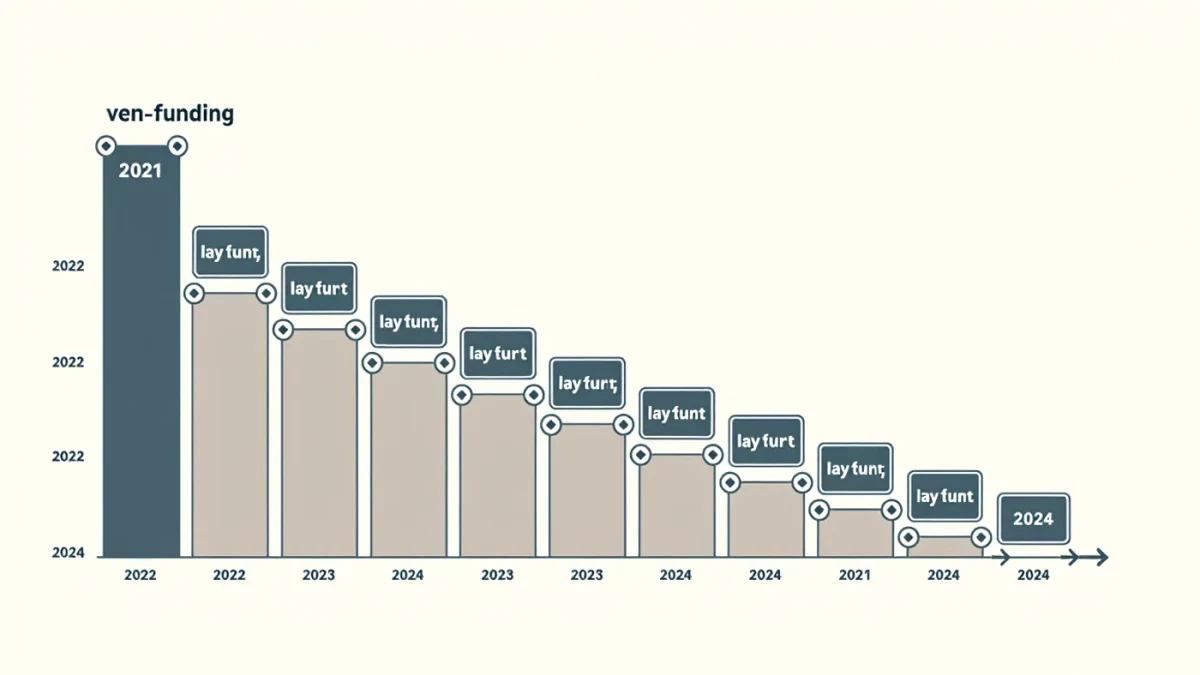
The creator economy's funding boom peaked in 2021 and corrected hard the following year, and the industry has been consolidating since: layoffs at the highest-profile startups, a delisting, fire sales and shutdowns, while the strongest companies absorbed the rest. The shakeout did not end creator businesses — it ended the assumption that every tool built around creators deserved venture-scale growth.
What happened after the 2021 funding peak?
Venture investors put a record sum into creator-economy startups in 2021 — trade-press tallies put the total above three billion dollars across hundreds of deals. When interest rates rose in 2022, growth-at-all-costs valuations repriced across technology, and the creator category's best-known companies began cutting staff within months.
The boom had funded a crowded middle layer: link-in-bio tools, tipping apps, creator banking and payroll services, NFT platforms for artists, monetization middleware, talent management software. Most shared one structural problem — they monetized a percentage of creator revenue that was, for the median creator, very small. The bull market priced the addressable audience; the correction priced the revenue.
By mid-2022 the reversal was public. Layoffs moved from general tech into the creator-specific names that had raised the most, and by 2023 the sector's shorthand changed from "creator economy startups" to "creator economy survivors" in trade coverage.
Which companies cut the deepest?
The largest cuts came from the category's most-funded consumer names between 2022 and 2024 — cameo marketplace Cameo, newsletter platform Substack, membership platform Patreon, talent brand FaZe Clan and, in live streaming, Twitch. The pattern repeated across dozens of smaller firms that wound down without headlines.
| Company | When | What happened |
|---|---|---|
| Cameo | May 2022 | Cut about 87 roles, roughly a quarter of staff, after pandemic-era growth reversed |
| Substack | June 2022 | Laid off 13 of its roughly 90 employees |
| Patreon | August 2022 | Cut about 17 percent of staff across several teams |
| FaZe Clan | 2022–2023 | Went public via SPAC in July 2022 near a $725 million valuation; stock collapsed, Nasdaq delisting followed in 2023, and the assets were bought by gaming company GameSquare |
| Twitch | January 2023 and January 2024 | Cut about 400 roles, then about 500 more — roughly 35 percent of staff — with leadership citing unsustainable cost growth |
Adjacent digital media tightened in the same window, which mattered because creator businesses sell into the same ad market: BuzzFeed shut down BuzzFeed News in April 2023, and Vice Media filed for Chapter 11 protection a month later before being sold to a lender group.
Why did the correction hit the sector so hard?
Three forces compounded: macro repricing, thin unit economics and platform risk. Rising rates punished pre-revenue growth stories everywhere, but creator tools were also a category whose revenue share model assumed creator incomes that mostly did not exist at the median.
Platform risk cut from the other side. The large platforms shipped native versions of the startups' core features — tipping, subscriptions, link pages, editing tools, even newsletters — turning whole product categories into commodities overnight. A venture-funded company cannot easily out-differentiate the platform it depends on when that platform decides the feature should be free.
Advertising compounded the squeeze. Creator ad revenue and influencer budgets held up better than feared, but brand spending shifted toward performance formats and proven channels, which favored large platforms and established agencies over experimental creator tooling.
Where did the companies end up?
Consolidation took three forms: acquisition, wind-down and pivot. Talent and marketing assets were bought by larger commerce, media and gaming companies; standalone tools with undifferentiated economics shut down; and a meaningful share of survivors pivoted from selling to creators to selling software to brands and agencies — influencer marketing platforms with dashboards, compliance and measurement.
The precedent is older than the boom. YouTube's multi-channel networks took as much as 45 percent of ad revenue in the mid-2010s in exchange for sales and rights services, and the category faded once monetization and payout terms improved. Maker Studios, the largest of them, sold to Disney in 2014 in a deal worth up to roughly $950 million with earnouts — and was eventually absorbed rather than operating as a standalone brand. Middle layers that monetize access to platforms tend to compress when the platforms open that access themselves.
Which parts of the sector grew through the shakeout?
The money did not leave the industry; it changed seats. Investment and acquisition interest through 2023 and 2024 concentrated in infrastructure with provable demand: payment and payout rails, brand-deal marketplaces with measurement attached, agency software for campaign compliance, and production tooling that cut editing hours.
The common thread is that the surviving businesses sell to parties with budgets — brands, agencies, platforms and full-time creator companies — rather than to the median creator. The consumer-facing boom assumed millions of creators would pay monthly for tools; the consolidated market bills the smaller number of parties whose revenue directly depends on creator output.
What does consolidation mean for working creators?
For creators, the shakeout meant fewer independent intermediaries and deeper dependence on the big platforms' native tools — the same platforms whose policy and payout changes drove the diversification advice in the first place. The durable infrastructure turned out to be the unglamorous layers: payments, email, memberships and direct sponsorship relationships.
The practical read, repeated across industry guidance since the correction, has three parts. Own the audience relationship wherever possible — email lists, direct payment rails, off-platform community. Diversify across platforms before it is forced, not after. And read the terms of every monetization tool, because the consolidation wave demonstrated how quickly a revenue dependency can be acquired, repriced or retired.
Is the creator economy shrinking, or just reorganizing?
The evidence points to reorganization rather than decline: widely cited annual benchmarks put global influencer-marketing spend above twenty billion dollars by 2024, and platform payouts to eligible creators kept growing off a large base. What shrank was the number of companies standing between creators and their audiences, not the underlying demand for creator attention.
That distinction defines the current structure. Capital now flows to infrastructure — payments, analytics, brand deal marketplaces — more than to consumer apps promising to make anyone a creator. The creators who treated the boom's tools as optional conveniences, and the correction as a reminder to hold their own audience data, came through the consolidation with more bargaining power, not less.