A paid newsletter converts attention into a direct subscription: readers pay a creator monthly for material that arrives by email, independent of any feed algorithm. The pivot works because the audience travels with the list, but the economics depend on a large free readership and a conversion rate that typically lands in single digits.
Why are creators pivoting to paid subscriptions?
Creators move to paid newsletters for three compounding reasons: platform risk, because feeds can change overnight; ownership, because the email list moves with the creator; and predictable revenue, because recurring subscriptions smooth out the swings of advertising and sponsorships. The trade is harder distribution and a standing publishing obligation.
Platform risk is the usual trigger. A channel that reaches an audience through a recommendation feed is renting that audience on terms it does not set, and terms do change — distribution tweaks, monetization eligibility, content policy. Email inverts the relationship: the subscriber list is exportable contact data, and the delivery pipe does not rank anything.
Revenue predictability is the second draw. Advertising pays in proportion to views, which swing; sponsorships arrive in lumps and end without notice. Subscriptions repeat until cancelled, which makes the income forecastable enough to plan production around — the same reason small software businesses favored them first.
How does the subscription math actually work?
Gross revenue equals paid subscribers multiplied by price. Subtract the platform's cut and payment processing, and a newsletter with 1,000 subscribers paying $5 a month grosses $60,000 a year but nets roughly $50,000 after a 10 percent platform fee and card processing, depending on billing period.
The processing detail matters more than it looks. Card fees have two parts — a percentage and a fixed amount per transaction — so monthly billing at $5 loses a visibly larger share to the fixed fee than annual billing at $60. Most successful paid newsletters push annual plans partly for retention and partly because the fee arithmetic is kinder.
| Paid subscribers | Price | Annual gross | Approx. net after 10% platform fee and processing* |
|---|---|---|---|
| 250 | $5/month | $15,000 | ≈ $12,500 |
| 1,000 | $5/month | $60,000 | ≈ $50,000 |
| 5,000 | $5/month | $300,000 | ≈ $253,000 |
*Illustrative figures assuming a 10 percent platform fee and published card-processing rates around 2.9 percent plus a fixed per-transaction charge; actual nets vary with billing period and platform. Platform fee structures are version-dated and subject to change.
What conversion rate can a creator expect?
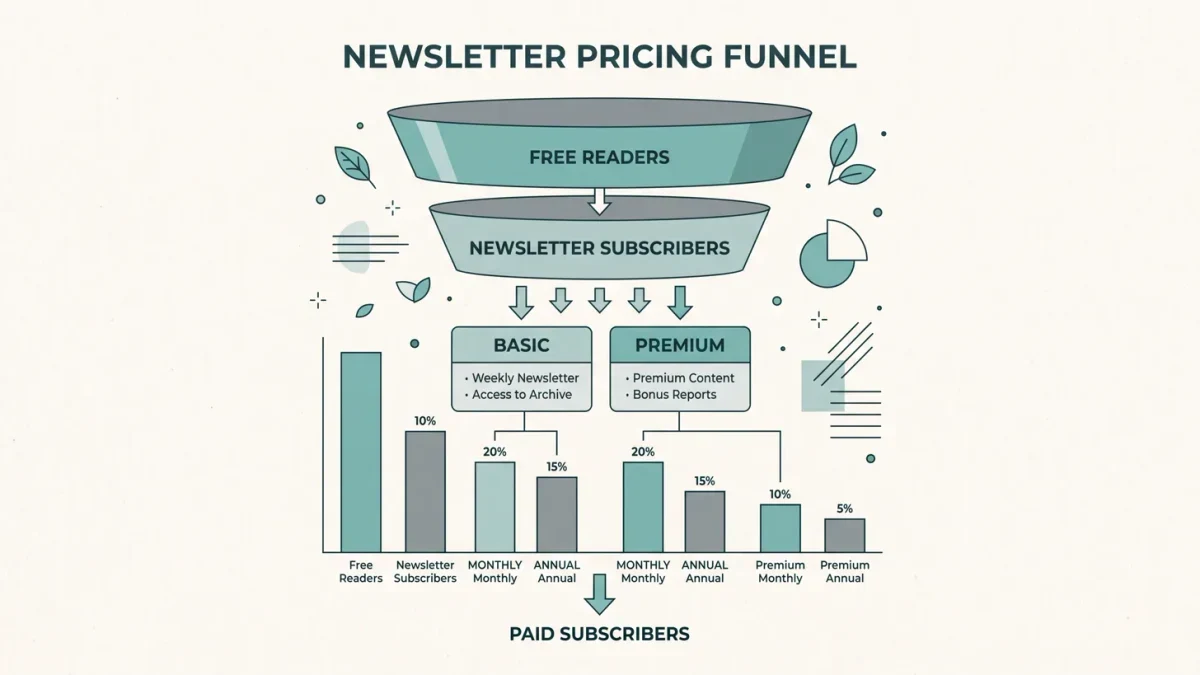
The commonly cited benchmark is that between 5 and 10 percent of an engaged free list eventually pays, with most newsletters landing nearer the low end. Conversion depends on cadence, how distinct the paid tier is, and whether the free product already solves a recurring problem readers want more of.
That benchmark sets the size of the free funnel. A creator wanting 1,000 paid subscribers at a 5 percent conversion rate needs roughly 20,000 engaged free readers — engaged being the operative word, since dead subscribers on a neglected list convert at effectively zero. This is why most successful pivots start six to twelve months before the paywall, building the free habit first.
Launch mechanics compress much of the conversion into a short window. A founding-member tier at a higher price with lifetime or long-running perks, an annual discount, and a clear public reason for the paywall — covering research time, going independent, expanding coverage — consistently outperform a quiet price appearing one morning.
What belongs behind the paywall?
The workable default is to keep most content free and charge for depth: full archives, deep-dive editions, datasets, community threads and Q&A access. The free tier stays the marketing engine — if everything valuable is locked, the funnel starves.
Splits commonly recommended to creators run from 80/20 to 90/10, free to paid. The paid promise has to be concrete: more of the thing readers already open, not a different product. A news-analysis writer sells deeper analysis; a deal-reporting writer sells earlier and fuller reporting; a niche-curation writer sells the full database and request line.
What does not work for long is paying-wall-by-scarcity — publishing irregularly free and locking the only consistent output. Readers reward a free tier that is genuinely useful on its own schedule, because that is the proof they are buying continuity of, not access to something withheld.
Which platforms host paid newsletters, and what do they charge?
Substack popularized the model and charges 10 percent of subscription revenue plus payment processing, as of 2025. Competitors split into two camps: revenue-share platforms and SaaS tools that charge a flat monthly fee instead of a percentage — cheaper at scale, more work up front.
| Platform | Business model | Typical cost structure (version-dated) |
|---|---|---|
| Substack | Revenue share | 10% of paid subscription revenue plus card processing |
| beehiiv | Tiered SaaS | Monthly plan fee; payments run through card processing |
| Kit (formerly ConvertKit) | Tiered SaaS | Monthly plan fee; paid-newsletter features on upper tiers |
| Ghost | Open-source plus hosting | Flat hosting fee; no revenue share |
| Patreon | Membership platform | Platform fee on pledges, historically in the 8–12% range, plus processing |
The structural choice is between paying a percentage forever and paying a fixed cost now. Small lists pay little either way; at several thousand paid subscribers, the percentage compounds enough that migrating to flat-fee tooling becomes a standard rite of passage. Platform pricing is version-dated and should be re-checked before any move.
What are the risks of the pivot?
The risks are churn, obligation and concentration. Subscribers cancel — commonly cited churn for paid newsletters runs in the mid-single digits monthly — promotional pricing resets hurt when the discount year ends, and the creator now owes a publication schedule to people who paid in advance.
Churn behaves in specific, learnable ways. It spikes after price increases and after the first renewal of discounted annual plans, which is why launch pricing at half off produces a cliff twelve months later. It also responds to cadence drops: a paid newsletter that misses its stated rhythm cancels faster than a magazine ever did, because cancelling is one tap.
Concentration risk is quieter. The list lives in a database, but payments run through a single processor and the habit runs through one inbox. Deliverability changes, payment disputes and platform policy are all real, which is why diversified newsletter businesses keep sponsorships or product revenue alongside subscriptions rather than betting everything on one recurring stream.