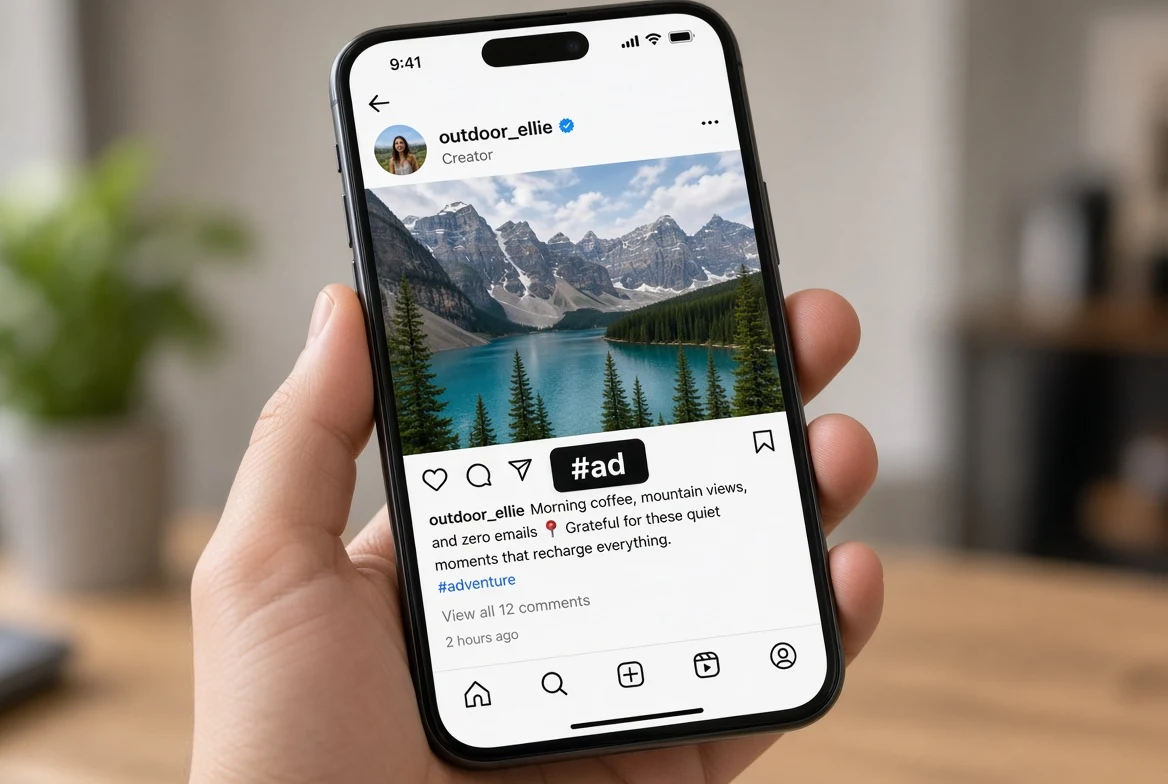
US rules require influencers to disclose any material connection to a brand (payment, free products, family or employment ties) whenever it could affect the weight readers give an endorsement. The Federal Trade Commission's Endorsement Guides, updated in June 2023, demand disclosures that are clear and conspicuous, and they leave both the brand and the poster exposed when they are not.
When does a post need a disclosure?
Whenever a material connection exists that audiences would not expect: cash, free or discounted product, affiliate commission, contest entries, employment or a family relationship. The trigger is the connection, not the wording of the post — even a genuinely held opinion must be disclosed if a brand paid for it to be shared.
The free-product case is the one that surprises most creators. Receiving an item with no obligation to post still creates the connection, because the expectation of future freebies can bias what gets reviewed. Affiliate links count even at trivial commissions, since a financial stake is a financial stake regardless of size.
What does not trigger disclosure is equally simple: a product bought at full price, with no brand relationship, reviewed on its merits. The rules police hidden incentives, not opinions.
What does clear and conspicuous actually mean?
The disclosure must be impossible to miss and easy to understand: #ad or "paid partnership with [brand]" at the start of a caption, visible without tapping "more," and in videos both spoken aloud and shown on screen. Anything an audience has to hunt for does not qualify.
Placement is the recurring failure. Disclosures buried at the end of a caption, hidden inside a block of unrelated hashtags, or flashed too briefly in a video have all drawn criticism from the agency. Platform tools help — Instagram's paid-partnership label is the best-known — but the FTC's own FAQ warns that a platform tool alone may not be sufficient, since reach and placement vary. The standard practice is to layer: platform label plus a plain-language line in the caption.
Vague tags do not qualify. Abbreviations and euphemisms — #sp, #collab, #ambassador used alone, "thanks to the brand" without saying why — have been called out as unclear, because a reader cannot tell what relationship the words describe. The disclosure also needs to be in the same language as the endorsement; an English #ad on a Spanish-language post fails the audience it actually has.
Ephemeral formats raise the bar rather than lowering it. A Story disappears, so the disclosure must appear on every frame that carries the endorsement, not only the first; a live stream needs the connection stated aloud at reasonable intervals, because viewers join mid-broadcast. The test stays constant: someone who sees only part of the content should still see the relationship.
What changed in the 2023 update?
The June 2023 revision was the first comprehensive update of the Endorsement Guides since 2009. It reaffirmed the clear-and-conspicuous standard, clarified that both marketers and endorsers can be liable for misleading endorsements, and added guidance aimed squarely at social media — including how the agency evaluates platform-provided disclosure tools.
The update also addressed newer territory. Virtual influencers — fictional personas run by companies — are covered, and the revisions discuss fake or misleading indicators of social influence, the umbrella that fake followers and bot engagement sit under. None of this changed the core duty; it modernized the examples around it.
For campaign operations, the practical addition was emphasis on monitoring: advertisers are expected to have reasonable programs to check that the influencers they pay actually disclose, rather than treating the obligation as the creator's problem alone.
What is the rule on fake reviews and testimonials?
A separate FTC rule finalized in 2024 bans fake reviews and testimonials, insider reviews written without disclosure of the relationship, and buying positive reviews, with civil penalties attached — above $50,000 per violation as of 2024, adjusted annually for inflation. It took effect October 21, 2024.
The rule aims at businesses rather than organic creator posts, but it reaches influencer campaigns wherever testimonial-style claims are involved: scripted praise presented as customer experience, reviews from employees posing as customers, and review-incentive programs that hide the inducement. For creators, the practical effect is the same as the Endorsement Guides' — fabricate or disguise a material connection, and someone in the transaction is exposed to enforcement.
Who has the FTC pursued in practice?
Enforcement has favored warnings first, cases second. In 2017 the agency sent warning letters to prominent Instagram influencers over inadequate disclosures, and in October 2021 it mailed Notices of Penalty Offenses to hundreds of consumer-product companies, putting them on formal notice that deceptive endorsements carry civil penalties.
The cases set the pattern for liability on both sides. In 2020, detox-tea marketer Teami settled FTC charges over inadequate influencer disclosures; the company paid $1 million of a larger suspended judgment, and several high-profile endorsers received warning letters for posts that failed to disclose the paid relationship. The lesson advertisers took: the brand's contract and monitoring program, not just the creator's caption, is what gets examined.
How does a compliant sponsored post look in practice?
A compliant post pairs a plain-language disclosure with correct placement and keeps evidence of the agreement. The checklist is short, and following it covers the overwhelming majority of campaigns:
- Start the caption with #ad or "Paid partnership with [brand]" — before the fold, before the jokes, before other hashtags.
- In video and live formats, disclose verbally near the start and reinforce it with an on-screen label of reasonable duration.
- Use the platform's paid-partnership tool in addition to, not instead of, the caption disclosure.
- Keep the disclosure in the language of the post and understandable without specialist knowledge.
- Disclose every format separately — a labeled video does not automatically cover the Stories repost.
- Keep the agreement, the brief and the invoice; both sides' exposure runs through the paper trail.
None of this is decoration. The FTC's FAQ — the agency's own plain-language walkthrough of these questions — is explicit that disclosure is not a safe harbor formula but a communication test: would an ordinary reader understand, without doubt, that the poster was paid? The answer has to be visible in the post itself.