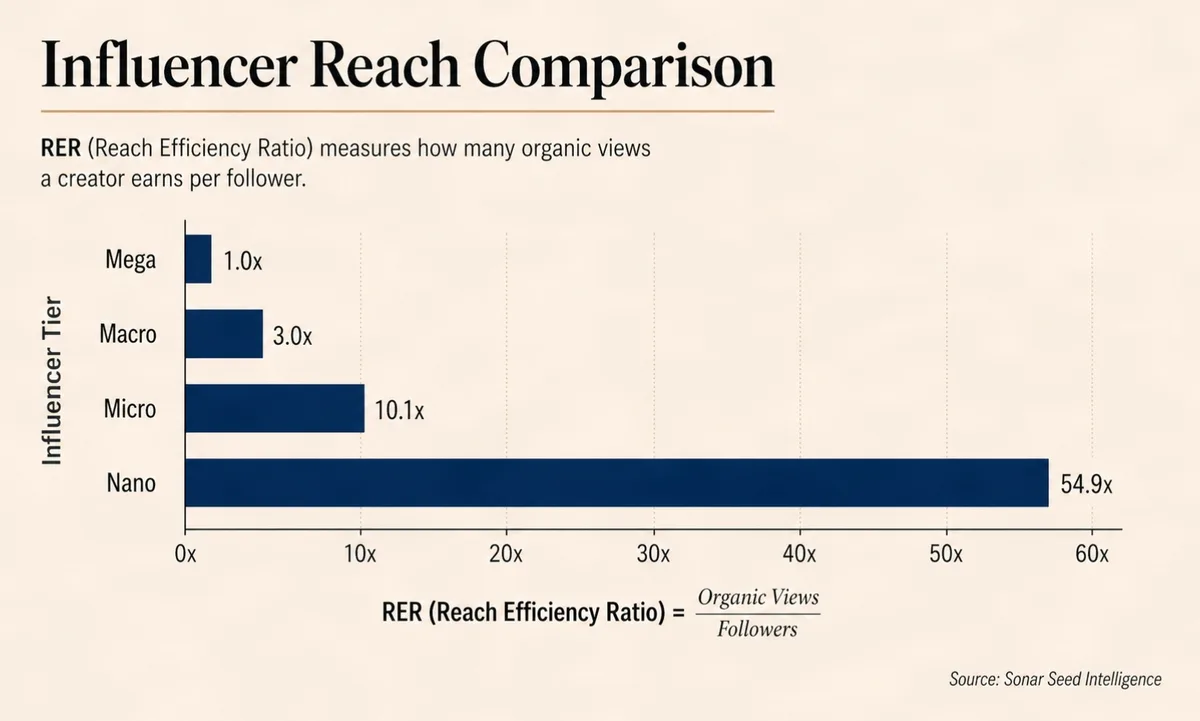
Micro-influencers generally charge less per post and deliver higher engagement; macro-influencers charge more and deliver reach. The honest comparison is not follower count against follower count but cost per engaged viewer: on benchmark numbers, a smaller account often wins that arithmetic, while a larger one wins awareness campaigns.
What counts as micro or macro?
Industry convention splits the scale into five tiers: nano under 10,000 followers, micro 10,000 to 100,000, mid-tier 100,000 to 500,000, macro 500,000 to one million, and mega above one million. The boundaries are loose conventions rather than standards, but buyers and platforms use them to set expectations for rates and reach.
The labels matter because they proxy for two different things at once: audience size and audience relationship. Micro usually implies a niche community where the creator is known personally to a meaningful share of followers. Macro implies broadcast — the audience is large, anonymous to the creator, and reached mainly through platform distribution.
| Tier | Followers | Benchmark rate, one Instagram post* | Typical engagement pattern |
|---|---|---|---|
| Nano | 1,000–10,000 | $10–$100 | Highest engagement rates in the market |
| Micro | 10,000–100,000 | $100–$500 | Above-average engagement, niche trust |
| Mid-tier | 100,000–500,000 | $500–$5,000 | Transition zone toward broadcast reach |
| Macro | 500,000–1,000,000 | $5,000–$10,000 | Lower engagement rate, broad reach |
| Mega | 1,000,000+ | $10,000+ | Lowest engagement rate, mass awareness |
*Benchmark ranges from widely used annual industry reports, survey-based and self-reported, as of 2024. Engagement patterns summarize the long-documented tendency for engagement rate to decline as accounts grow.
Why does engagement fall as accounts grow?
Engagement rate declines with scale for mechanical reasons: as distribution shifts from a self-selected community to algorithmic broadcast, the average follower's connection to the creator weakens. Industry audits, including HypeAuditor's recurring reports, have documented the inverse relationship between follower count and engagement rate across Instagram for years.
The community explanation does most of the work at the small end. A 20,000-follower account built around a specific craft has followers who chose it deliberately, comment in a shared vocabulary and trust recommendations. A 700,000-follower account reached many of its followers through recommended content; they opted into seeing a video, not into a relationship.
Neither state is better in the abstract — they are different products. What the decline means commercially is that a macro account's price must be justified by reach, since it will rarely win a cost-per-engagement comparison against a healthy micro account in the same niche.
How do you compare cost per engagement?
Cost per engagement divides the post's price by the engagements it is expected to produce: rate divided by followers times the engagement rate. It converts follower count and engagement into one number a buyer can compare across any account size.
| Illustrative buy | Followers | Engagement rate | Expected engagements | Rate | Cost per engagement |
|---|---|---|---|---|---|
| Micro | 50,000 | 3.5% | 1,750 | $350 | $0.20 |
| Macro | 750,000 | 1.2% | 9,000 | $7,500 | $0.83 |
The figures are illustrative, built from benchmark midpoints rather than any real account. The structure of the result is what generalizes: at these inputs, the micro post reaches fewer people but buys each engagement at roughly a quarter of the macro price, while the macro post buys volume and breadth a collection of small accounts cannot schedule in one day.
When is a macro-influencer the better buy?
Macro accounts earn their premium when the campaign goal is broad awareness on a clock: a launch, a seasonal window, a rebrand, a market entry. One negotiated contract, one production standard and one publication date deliver millions of coordinated impressions — coordination no portfolio of micro accounts can match on deadline.
Macro also buys production quality and reduced coordination risk. Larger accounts usually have teams, established sponsorship formats and professional output, which matters when the asset will run beyond organic posting. And for brands, a familiar face carries a signal that a portfolio of unknown niche creators cannot replicate.
The frequency argument runs the other way. Several micro posts across a niche outperform one macro post for driving repetition within a target community, because the same buyer sees the message multiple times from voices they trust. Awareness wants breadth; conversion wants repetition and trust.
Where do nano accounts fit in?
Nano — under 10,000 followers — is where the tier logic starts rather than where it ends. Rates are nominal, often product-based, but engagement runs highest of any tier, and brands use nano layers for seeding: product to many small accounts, then paid amplification of whichever posts overperform.
For the accounts themselves, nano is the proving ground. The work builds a portfolio, tests formats and generates the case studies that justify the first real quotes. Pricing discipline matters even here: a nano account that gives away usage rights and exclusivity for product learns habits that cost real money two tiers later.
What about the mid-tier middle?
Mid-tier — roughly 100,000 to 500,000 followers — is the compromise band and often the hardest to price. The account is usually too big for the pure community dynamic of micro and too small for guaranteed broadcast reach, so buyers hedge: rates benchmark between the two, and the deciding evidence is whether engagement has held as the account grew.
For creators, mid-tier is where professionalization pays. An account that keeps micro-level engagement while adding scale can quote above the table, because it delivers both products at once. An account whose engagement slid with growth gets negotiated down toward pure reach pricing.
How do brands with fixed budgets split the difference?
The standard playbook is a portfolio: one macro anchor for reach and credibility, a layer of micro and nano accounts for trusted repetition inside the target niche, and measurement that separates the two jobs in reporting. Budget splits vary by goal, but the logic of pairing rather than choosing is consistent across agency practice.
The pairing also hedges risk. Audience audits can disqualify a macro account late in planning; a portfolio absorbs that loss. A single micro post can under-deliver for reasons unrelated to quality; a portfolio averages it out. Diversification in influencer buying works for the same reason it works anywhere else.
For creators, the same tables set expectations from both sides. A micro account quoting near macro prices needs engagement evidence to justify it, and a macro account with weak engagement should expect buyers to negotiate against the benchmark — because the arithmetic on cost per engagement is the first spreadsheet every agency opens.