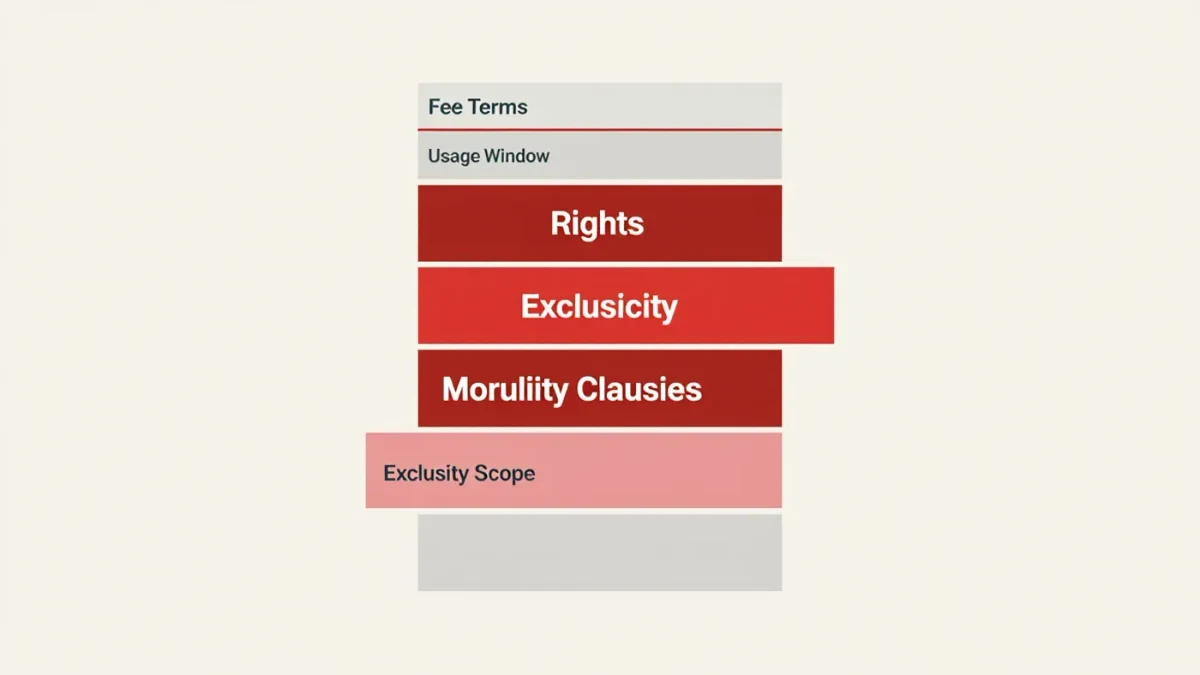
The clauses that cost creators the most are usually not the fee terms but the rights, exclusivity and termination provisions buried in standard templates. A fair brand deal exchanges defined content for defined payment. A dangerous one acquires the archive, blocks whole product categories for years, or lets the brand exit without paying on a subjective judgment.
Why are rights clauses the first thing to check?
Rights clauses define what the brand can do with the content after the campaign. The red flag version grants the brand a perpetual, irrevocable, worldwide license to reuse, edit and resell the creator's content and likeness — in advertising, in paid media, even to third parties — for a fee calculated for one social post. Once signed, the creator cannot relicense that material and may find their own face promoting a brand years after the relationship ended.
The reasonable middle ground is a defined usage window: organic use on the brand's own channels for the campaign term, with paid media (whitelisting, Spark Ads, running the content as ads) priced separately and time-limited. Paid usage rights are a standard upsell, and the market convention is to charge a percentage of the base fee for additional months of paid usage.
What does an overbroad exclusivity clause look like?
Exclusivity prevents the creator from working with competitors. Flagged versions define the competitor category so widely — 'all beverages' instead of 'sparkling water', 'all financial technology' instead of the specific product — or run so long (12 to 24 months, unpaid) that they shut the creator out of their primary income category. A fitness creator locked out of supplements, apps and apparel for a year has lost most of a sponsorship season, not one deal.
The negotiation standard: exclusivity should be narrow (named competitors or a tight category), short (30 to 90 days around the campaign), and paid — either as part of the fee or as an explicit carve-out line. If a brand wants a year of category exclusivity, that is a materially different purchase and should be priced like one.
What is a morality clause and why is it risky?
A morality clause lets the brand terminate — and sometimes claw back fees — if the creator engages in conduct that, in the brand's judgment, harms its reputation. The provision descends from talent contracts and appears in most sponsorship agreements. The red flag is not its existence but its subjectivity: unilateral brand judgment, undefined 'disparaging conduct', and remedies that include refunding the full fee.
Creators should push for mutual morality clauses (the brand's conduct can trigger exit too), objective standards of actual public disrepute rather than perceived risk, notice-and-cure periods, and termination as the only remedy rather than fee clawback. What a creator says on their own channel outside the campaign is a particular battleground — the strongest versions of these clauses have been read to cover all of a creator's public speech, which for a commentary or news-adjacent creator is unworkable.
Which payment terms cause real losses?
The practical payment red flags: payment net-60 or later after posting rather than a deposit; no kill fee if the brand cancels after content is produced; payment contingent on performance metrics the creator does not control; and 'pay per post live' terms that let a brand delay publication indefinitely and thus delay payment indefinitely.
Market convention worth holding: 50 percent deposit on signing, balance on delivery or publication, and a kill fee covering work completed if the campaign is cancelled. Creators who work with agencies should also confirm whether the agency is contracting as principal or agent — who actually owes the money if things go wrong.
What other provisions deserve scrutiny?
Five more recur in creator agreements:
- Perpetual renewals: auto-renewing terms that continue unless cancelled in a narrow window.
- Approval loops: unlimited revision rounds with no cap, converting a fixed fee into unpaid weeks of work.
- Content ownership of the underlying assets: brand ownership of raw footage, not just finished posts.
- Disclosure waivers: any language asking the creator not to mark the post as sponsored — unenforceable against regulators, and a signal about the partner.
- Indemnification asymmetry: creator indemnifies the brand for everything, including the brand's own use of the content, with no reciprocal protection.
How should creators negotiate without losing the deal?
Most red flags are template defaults, not dealbreakers, and brands expect negotiation. The working sequence:
- Flag specific clauses by name and ask for the standard fix — time-limited usage, narrow exclusivity, mutual morality terms.
- Offer pricing for what the brand actually wants: a 12-month paid usage license or year-long exclusivity is an upsell, not a refusal.
- Keep disclosure terms non-negotiable: sponsored content will be marked, full stop.
- Get every agreed change in a written amendment, not email assurances.
A brand that refuses all modification of one-sided terms is providing information about the relationship ahead. Walking away from a bad contract is usually cheaper than performing one.
What does a clean deal look like for comparison?
A well-drafted sponsorship leaves no ambiguity on six points: deliverables (exact number of posts, platforms, formats and deadlines), fee and payment schedule with deposit, usage rights limited to named channels and a stated term, exclusivity scoped to named competitors for a defined window, disclosure obligations stated openly rather than waived, and termination terms including a kill fee. Reading a proposed contract against that checklist takes minutes and surfaces most problems immediately.
Creators who publish regularly with brands often move to a master agreement plus per-campaign statements, which fixes protective terms once and keeps individual deals short. The arrangement reduces both legal spend and the temptation to skip review on smaller deals — where the same risky templates circulate just as often.
When is a lawyer worth the cost?
For small one-post deals, a creator familiar with the standard flags can self-review. The threshold for professional review: any deal above a few thousand dollars, anything with multi-month exclusivity, anything involving content ownership or likeness licensing beyond the campaign, and any agreement presented as a long-term partnership. Entertainment and media lawyers typically review a standard sponsorship agreement for a flat fee that is small relative to the exposure these clauses create.